What this service covers
Active soil depressurization sized to the foundation in front of you: a deep Denver basement, a postwar slab, a crawl space, or the structural floor over a void that expansive Douglas County soils force on some builders. Colorado has licensed this trade since July 1, 2022, so every install here is performed by a state-licensed radon mitigation professional holding an NRPP or NRSB credential, built to ANSI/AARST SGM-SF-2023, and confirmed with a follow-up radon measurement once the fan has run.
Typical pricing
$1,100-$2,200
Pricing varies by job specifics. Free phone or on-site quotes; fixed pricing once the technician has assessed the job.
What a mile-high radon system is actually doing
Soil gas moves toward low pressure, and a heated Front Range house is a low-pressure zone for a large part of the year. Warm indoor air rises and leaks out high in the building, the lowest level makes up the difference, and some of that make-up air arrives through the dirt. Denver adds its own twist: a long heating season, big day-to-night temperature swings, and furnaces and water heaters that all pull combustion air, so the stack effect that drives radon entry here is strong and persistent.
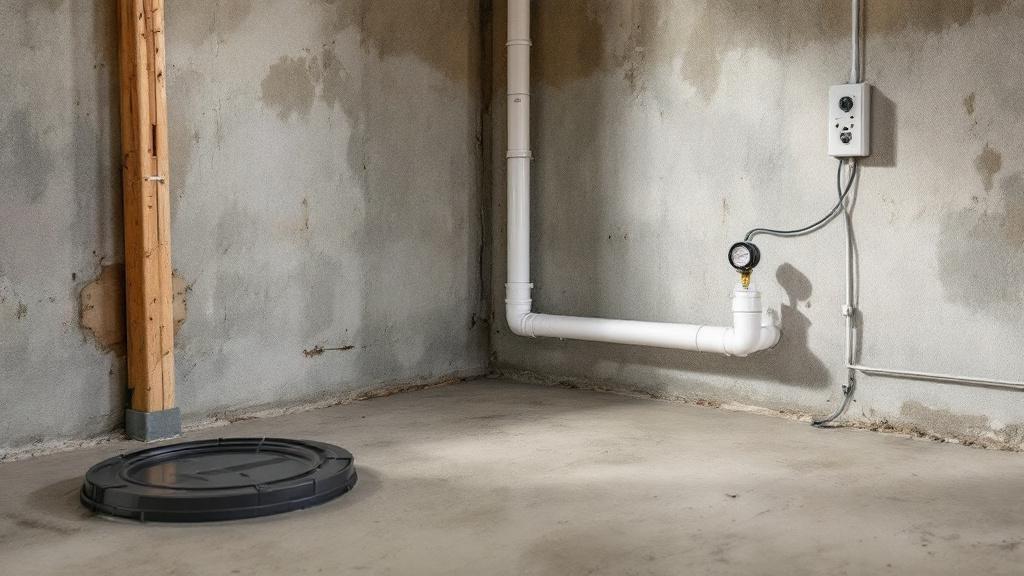
A mitigation system reverses the gradient at the source. A suction cavity is opened under the slab or under a sealed crawl membrane, piped to a continuously running inline fan, and exhausted above the roof, so the soil immediately beneath the foundation sits at lower pressure than the room above it. The gas that used to seep through the floor-wall joint and the cracks rides the pipe instead. The EPA's consumer guidance puts well-executed active sub-slab suction among the most effective reduction methods available for homes.
Design is where metro Denver jobs differ from the textbook. Much of the basin is claystone and clay-rich fill that moves air grudgingly, so the pit under the suction point is excavated larger here than in gravel country, and diagnostics decide whether one suction point can serve the whole footprint. Our pricing guide by foundation type shows how those findings become a quote.
Licensing and standards on every Colorado install
Since July 1, 2022, Colorado law has required anyone performing radon mitigation for pay to hold a state license from the Division of Professions and Occupations at DORA, under Title 12, Article 165 of the Colorado Revised Statutes. The license sits on top of a national credential: an applicant first earns NRPP or NRSB certification, then registers with the state, which can discipline a licensee the way it can any other regulated professional. Measurement for pay carries its own license. CDPHE handles public awareness and test kits, but the regulator of the people doing the work is DORA.
The technical rulebook is national. Licensed mitigation work follows ANSI/AARST SGM-SF-2023 for single-family homes, which governs where the fan may be placed (attic, garage with no living space above, or outdoors, never below the living envelope), how the discharge clears the roofline and nearby openings, the labeling, the pressure gauge on the pipe, and the sealing that keeps the fan pulling on soil instead of on your basement air.
Two practical consequences for a homeowner. First, you can verify any name on a proposal against DORA's license lookup before signing, the same way you would check an electrician. Second, a quote from an unlicensed operator is not a bargain; it is a job the state says cannot legally be sold. See how to check a Colorado radon license.
How Denver-area houses change the design
The metro's housing eras each pose a different problem. Pre-war Denver neighborhoods like Washington Park, Berkeley, and Park Hill sit on brick and stone foundations with cellars and floors poured long after the walls, so entry paths are scattered and sealing is a real line item. Postwar ranches across Lakewood, Wheat Ridge, and Englewood bring partial basements beside crawl spaces, which often means a system that treats two foundation types at once.
The 1970s and 80s belt through Westminster, Thornton, Aurora, and Centennial is split-level and tri-level country, where the lowest finished level is living space and readings there matter most. South of the city, expansive claystone pushed many Douglas County builders to structural wood floors spanning a ventilated void, and that void, not a slab, is what the system has to depressurize, a design question most national guides never mention.
Newer subdivisions from Broomfield to Castle Rock frequently include a builder's passive rough-in where a local code required radon-resistant construction. A passive pipe helps, but it relies on warm-pipe buoyancy alone; when a new house still tests at 4 pCi/L or more, the usual fix is converting it with a fan, a smaller job than a full retrofit. The passive versus active comparison covers that decision.
What a Denver mitigation quote should spell out
Most metro Denver basement and slab systems land between $1,100 and $2,200 installed; crawl spaces needing a sealed membrane usually run $1,600 to $3,200, and converting a builder's passive pipe runs $650 to $1,100. Behind any of those numbers, a proposal worth signing names the license number of the mitigation professional, the suction point locations and the diagnostics behind them, the fan model and where it mounts, the discharge route, the sealing scope, and the follow-up measurement that proves the result.
Ask two questions before you sign. What does the system guarantee, stated as a number and its conditions, and what happens if the post-install test misses it? And what will the system cost to run, since the fan draws power around the clock and, in winter, pulls some conditioned air with the soil gas? An installer working to the AARST standard will have ready answers, because the standard requires the components those answers describe: the labeled pipe, the performance indicator, the sealed accessible openings.
When the house is on a purchase contract the sequencing tightens, and the real estate radon service page covers how installs get scheduled against a closing date. For everything else, the calculator gives a starting range and the written quote follows a site visit.
Service area
Radon Mitigation Systems is available across Denver and the Front Range metro. Per-suburb pages: